
AI Can Now Design Viruses That Never Existed in Nature — Here’s What Scientists Actually Did
What if artificial intelligence could create something that had never existed in nature?
Not an image.
Not a video.
Not computer code.
But a biological genome.
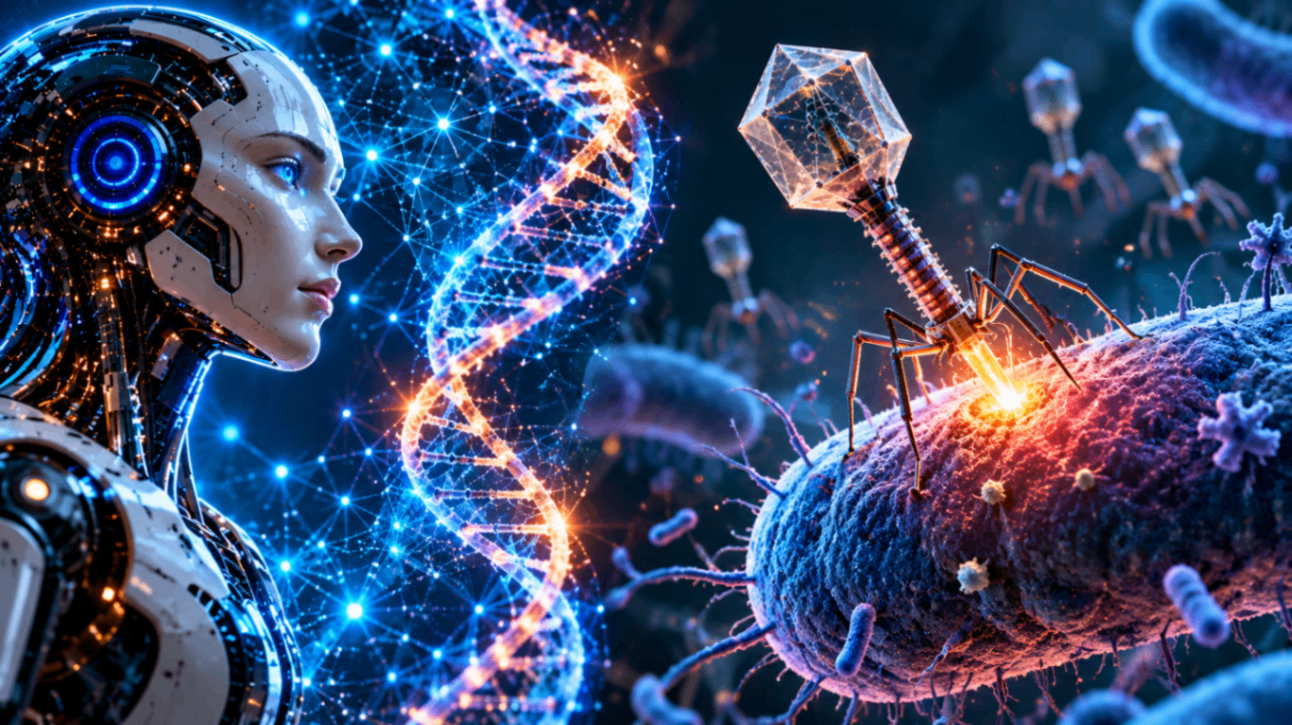
That sounds like science fiction, but researchers have already demonstrated something remarkably close: using generative AI to design bacteriophages — viruses that infect bacteria.
And some of the resulting AI-designed phages were functional.
That immediately creates a terrifying headline:
“AI created new viruses.”
But the reality is much more interesting — and much more nuanced.
First: These Were Not Human Viruses
This distinction is extremely important.
The experiments involved bacteriophages, commonly called phages.
Phages are viruses that infect bacteria, rather than humans.
They are everywhere.
In soil.
In oceans.
Inside ecosystems.
And even inside the human body, where enormous populations of bacteria and bacteriophages coexist.
Researchers have studied phages for decades because some of them can destroy bacteria.
That creates an intriguing medical possibility.
Why Would Scientists Want AI to Design Viruses?
Because bacteria are becoming harder to kill.
Antibiotic resistance is one of the world's major medical challenges.
When bacteria repeatedly encounter antibiotics, evolutionary pressure can favor resistant strains.
Eventually, medicines that once worked extremely well may become less effective.
Scientists have therefore been investigating another weapon:
phage therapy.
Instead of using a chemical antibiotic to kill bacteria, researchers can potentially use bacteriophages that specifically attack particular bacterial cells.
Imagine a biological guided missile whose target is a bacterium.
Now add artificial intelligence.
Instead of searching nature endlessly for the perfect phage, scientists could potentially use AI to help design biological sequences with desired properties.
That's where things become extremely interesting.
How Can AI Design Biology?
Most people know generative AI through systems that predict language.
You give an AI model text.
It predicts what should come next.
But biological information can also be represented as sequences.
DNA uses four fundamental nucleotide bases:
A, T, C and G.
Proteins are constructed from sequences of amino acids.
These biological sequences contain patterns.
And machine-learning models can learn patterns.
The basic idea is similar to generative AI for language.
A language model learns relationships between words and tokens.
A biological model learns relationships inside biological sequences.
Then researchers can ask the system to generate sequences that satisfy particular constraints.
That field is sometimes called generative biology.
From Digital Sequence to Physical Biology
This is where the story becomes fundamentally different from ChatGPT generating a paragraph.
An AI-generated biological sequence can potentially be synthesized.
In simplified terms, researchers can:
use AI to generate a biological design,
convert that design into DNA,
synthesize the DNA,
introduce it into an appropriate laboratory system,
and test whether the resulting biological structure works.
That means the output doesn't necessarily remain inside a computer.
It can potentially become physical biology.
And that's why generative biology deserves serious attention.
Could This Lead to New Medicines?
Potentially, yes.
AI-assisted biological design could eventually help scientists develop:
new proteins,
enzymes,
antibodies,
vaccines,
phages,
therapeutics,
and biological materials.
Traditionally, researchers may need to search enormous biological spaces through experiments.
AI can help narrow the search.
Imagine trying to find one useful design among billions or trillions of possibilities.
A machine-learning model can potentially identify promising regions of that enormous search space before expensive laboratory testing begins.
This could dramatically accelerate biotechnology.
But There Is Another Side
The same capability raises an obvious question.
If AI becomes extremely good at designing useful biology, could the technology also be misused?
This is known as a dual-use problem.
The same scientific knowledge can have beneficial and harmful applications.
Nuclear physics can produce electricity or weapons.
Cybersecurity knowledge can protect systems or attack them.
Synthetic biology can create medicine — but biological engineering also requires safeguards.
AI increases the importance of those safeguards because it can make complicated scientific knowledge easier to analyze and potentially easier to use.
Can AI Create the Next COVID-19?
This is where sensational headlines can become misleading.
The fact that researchers can use AI to design bacteriophages does not mean someone can simply type:
“Create the next COVID”
into a chatbot and receive a pandemic.
Human pathogens are extraordinarily complicated.
A virus capable of infecting humans must successfully interact with cells, reproduce, evade biological defenses, transmit between hosts and remain viable under real-world conditions.
Predicting all of that is enormously difficult.
Biology is not software.
You cannot assume that because a sequence looks promising on a computer, it will behave exactly as predicted inside a living organism.
Laboratory experimentation remains essential.
So the correct conclusion is not:
“AI can now instantly create pandemics.”
But it would also be irresponsible to conclude:
“There is absolutely nothing to worry about.”
The technology is advancing.
That means biosecurity needs to advance with it.
The Bigger Revolution: Generative Biology
The biggest story may not actually be viruses.
It is the convergence of:
AI + biology.
During the first generative-AI boom, machines learned to generate:
text,
images,
music,
video,
and software.
The next frontier is different.
AI systems are increasingly being used to generate or optimize things in the physical world.
Proteins.
Molecules.
Materials.
Drugs.
And biological sequences.
Instead of asking AI to generate pixels, scientists can ask it to explore the building blocks of life.
That could become one of the most consequential applications of artificial intelligence.
Why Africa Should Pay Attention
Africa shouldn't view biotechnology and artificial intelligence as completely separate industries.
The combination could eventually affect:
agriculture,
healthcare,
disease detection,
drug discovery,
food production,
veterinary medicine,
and environmental science.
For Ethiopia, AI-powered biological research could eventually contribute to locally relevant challenges involving agriculture, livestock, infectious diseases and medical research.
But participation requires more than downloading an AI model.
Countries need:
laboratories,
universities,
biological datasets,
high-performance computing,
trained researchers,
regulation,
and biosecurity infrastructure.
The countries building those capabilities today may become the biotechnology leaders of tomorrow.
We Are Moving From Generating Content to Generating Reality
This may be the most important takeaway.
The first generation of AI impressed us because machines could generate things on a screen.
A photograph that never existed.
A voice that never spoke.
A video that was never filmed.
But AI is increasingly moving beyond digital content.
When artificial intelligence helps design a protein, molecule, material or biological genome, its output can potentially become something physical.
That changes the stakes.
The AI revolution is no longer only about information.
Increasingly, it is about designing the physical world itself.
And that may be far more transformative than the chatbot revolution that started it.
FAQ
Did AI really create a virus?
Researchers have demonstrated generative-AI approaches for designing bacteriophage genomes. Bacteriophages are viruses that infect bacteria, not humans.
Were these viruses dangerous to humans?
The research discussed here concerns bacteriophages targeting bacteria rather than human-infecting viruses.
What is a bacteriophage?
A bacteriophage is a virus that infects bacteria. Scientists are studying phages for applications including alternatives or complements to traditional antibiotics.
Could AI design medicines?
Yes. AI is already being researched for protein design, drug discovery, molecular design and other biotechnology applications.
Could AI create a pandemic?
AI-designed bacteriophages do not demonstrate that AI can simply generate a viable pandemic pathogen. Human pathogens involve far more complex biological requirements. However, advances in AI-assisted biology are increasing the importance of strong biosecurity controls.
What is generative biology?
Generative biology uses AI models to design or optimize biological structures and sequences, such as proteins, DNA and potentially other biological systems.