

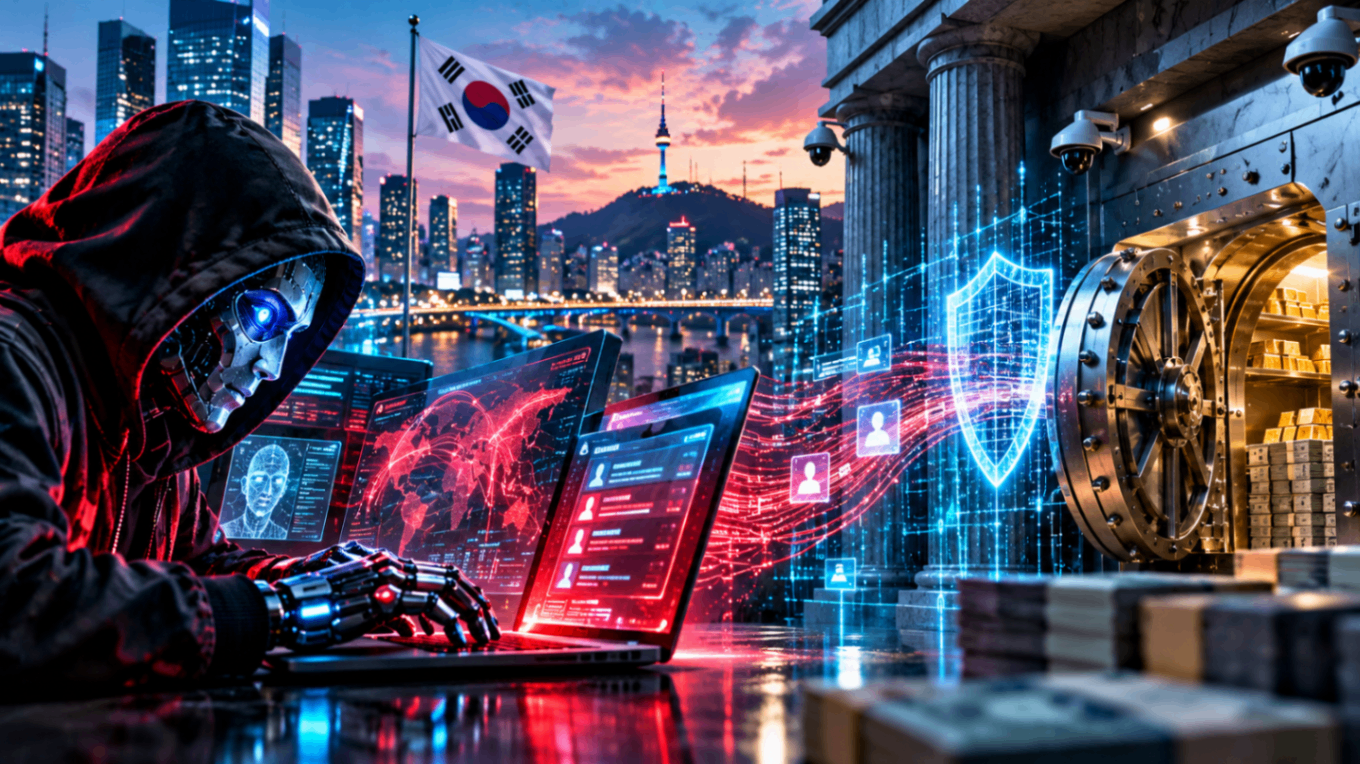
AI Is Now Being Used to Hack Banks — South Korea’s Warning to the World
Artificial intelligence was supposed to help banks detect hackers.
Now governments are investigating whether hackers are using AI against the banks themselves.
South Korean President Lee Jae Myung revealed on October 6 that authorities had found signs suggesting artificial-intelligence models were involved in some recent hacking incidents targeting the country's banking sector.
And this story could represent something much bigger than another data breach.
We may be entering the era of AI-versus-AI cybersecurity.
What Happened in South Korea?
A series of cyberattacks recently hit South Korean financial institutions.
Among the institutions that reported incidents were major banks including:
Shinhan Bank,
KB Kookmin Bank,
Hana Bank,
and Woori Bank.
The attacks resulted in breaches involving customer information and triggered investigations by police, financial regulators and cybersecurity authorities.
South Korea's Financial Services Commission also convened an emergency meeting involving regulators and financial-industry representatives.
But then came the detail that made this story much more significant.
Authorities found indications that AI may have been used during some of the attacks.
Exactly what role AI played has not yet been publicly established.
That distinction is important.
We should not interpret the investigation as proof that an autonomous superintelligent AI independently decided to hack banks.
Instead, investigators are examining whether attackers used AI-powered tools as part of their operations.
Why Would Hackers Use AI?
Traditional hacking requires time.
An attacker may need to:
discover a vulnerable system,
analyze the software,
search for vulnerabilities,
write or modify code,
test an exploit,
study security responses,
and repeat the process.
AI could potentially accelerate several parts of this workflow.
For example, AI systems can analyze large amounts of technical information far faster than a human can manually read it.
They can also assist with programming, debugging, research and pattern recognition.
That doesn't magically make every AI model a hacker.
But it can increase the productivity of someone who already understands cybersecurity.
Think about what calculators did for mathematics.
The calculator didn't invent mathematics.
It made certain calculations dramatically faster.
AI could potentially have a similar effect on parts of cyber operations.
Seven Financial Companies Reportedly Affected
South Korean reporting indicates that the incidents extended beyond one or two banks.
Multiple financial institutions have reported information leaks or cybersecurity incidents.
This is one reason authorities are taking the situation seriously.
South Korea's financial regulators have ordered institutions to examine externally exposed systems, strengthen authentication and access controls, review vulnerabilities and improve intrusion detection.
One particularly important lesson has already emerged.
Attackers don't always need to break directly into the most protected core banking system.
Sometimes the weakest point is somewhere else.
An external website.
A third-party service.
An employee portal.
A forgotten server.
Or a system created for convenience that doesn't receive the same security attention as the core infrastructure.
Cybersecurity is often only as strong as the weakest connected system.
AI Changes the Economics of Cybercrime
This may become one of AI's most important cybersecurity consequences.
Imagine a hacker who can normally investigate ten systems.
Give that attacker powerful AI tools and perhaps they can investigate hundreds.
The danger isn't necessarily that AI suddenly becomes an independent criminal mastermind.
The danger is automation and scale.
AI can potentially help attackers perform repetitive tasks faster.
That means vulnerabilities that previously weren't worth manually investigating could become economical to attack.
And that changes the cybersecurity equation.
The Rise of AI Agents Makes This Even More Important
Today's chatbots mostly wait for instructions.
AI agents are different.
An agent can potentially perform a sequence of actions toward a goal.
For legitimate developers, this is incredibly powerful.
An AI coding agent could:
inspect software,
find bugs,
modify code,
run tests,
read documentation,
and repeat the process.
But the same underlying capabilities create an obvious cybersecurity question.
What happens when similar technology is deliberately pointed at vulnerable infrastructure?
The answer is becoming one of the biggest security questions of the AI era.
AI Attackers vs AI Defenders
There is another side to this story.
Banks can use AI too.
AI-powered cybersecurity systems can potentially monitor enormous quantities of network activity and identify unusual behavior faster than traditional manual security teams.
Future cybersecurity could therefore increasingly become:
AI attacking systems versus AI defending systems.
An attacker deploys automated reconnaissance.
The defender deploys automated detection.
The attacker changes techniques.
The defensive system adapts.
And both sides operate increasingly quickly.
Humans may eventually supervise a cybersecurity battle happening at machine speed.
Why Banks Are Attractive Targets
Banks hold three extremely valuable resources:
Money.Personal information.Trust.Even when attackers don't steal money directly, stolen customer information can still be extremely valuable.
Names, identification information, contact details and account-related information can potentially be used for phishing, impersonation and other forms of fraud.
Banks therefore need to protect much more than account balances.
They protect identity infrastructure.
What Does This Mean for Ethiopia and Africa?
This story should matter to African financial institutions.
Banking across Africa is becoming increasingly digital.
Mobile banking, digital wallets, fintech platforms, payment APIs and online banking systems are connecting millions of customers to financial services.
That creates enormous opportunities.
But every new connection can also create another potential attack surface.
African banks and fintech companies therefore shouldn't think of AI only as a customer-service technology.
AI is increasingly becoming a cybersecurity issue.
Organizations need to ask:
What systems are publicly exposed?
Which third parties have access?
Are old servers still connected?
Are employee portals properly protected?
How quickly can suspicious activity be detected?
What happens when an attacker uses AI to probe the infrastructure continuously?
These questions are becoming increasingly important.
Small Businesses Should Pay Attention Too
You don't need to operate a bank to be affected.
AI can potentially make phishing emails more convincing.
Fake invoices can become more realistic.
Impersonation messages can become better written.
Voice cloning can imitate executives.
Automated systems can scan websites looking for vulnerabilities.
A small Ethiopian business running an outdated website, ERP installation or poorly configured server could therefore become an easier target.
The cybersecurity strategy of:
“We're too small for hackers to care about us”
is becoming increasingly dangerous.
Automation means attackers don't necessarily have to personally choose every victim.
Software can search for vulnerable systems automatically.
The Most Important Cybersecurity Rule Hasn't Changed
Ironically, even as AI becomes more sophisticated, many successful attacks still begin with ordinary security weaknesses.
Weak passwords.
Unpatched software.
Exposed servers.
Poor access controls.
Misconfigured systems.
Phishing.
Third-party vulnerabilities.
AI doesn't eliminate these problems.
It can make finding and exploiting them faster.
Organizations therefore need both advanced cybersecurity technology and basic security discipline.
The Bigger Story
The South Korean investigation isn't important only because banks were attacked.
It may be a preview of a new cybersecurity environment.
For decades, cyberattacks were primarily limited by human time and expertise.
AI can reduce that limitation.
One skilled attacker assisted by powerful AI systems could potentially perform work that previously required a much larger team.
At the same time, defenders will deploy AI to detect those attacks.
That means the future of cybersecurity could become a technological arms race.
AI versus AI.
And the organizations that don't prepare for that transition could become the easiest targets.
FAQ
Did AI hack South Korean banks?
South Korean authorities say there are signs AI models were used in some recent hacking incidents. Investigators have not yet publicly established the exact AI tools used or precisely how AI contributed to each breach.
Which South Korean banks were targeted?
Reported incidents have affected several financial institutions, including Shinhan Bank, KB Kookmin Bank, Hana Bank and others.
Can AI hack a bank automatically?
AI can assist with activities such as coding, research, vulnerability analysis and automation. That does not mean current AI systems automatically become autonomous hackers without human direction.
Why is AI dangerous for cybersecurity?
AI can potentially increase the speed and scale at which attackers research targets, generate malicious content or identify vulnerabilities.
Can AI also stop hackers?
Yes. Cybersecurity companies and organizations can use AI to detect unusual network behavior, analyze threats and automate parts of incident response.
Should ordinary people worry?
Consumers should continue following basic security practices including strong unique passwords, multi-factor authentication, software updates and skepticism toward unexpected messages requesting passwords, codes or payments.